NEOSSat
Canada's Near Earth Object Surveillance Satellite — a 15 cm optical telescope in Sun-synchronous orbit, re-engineered for long-duration, stable pointing and precision photometry of comets, asteroids, and exoplanet-hosting stars.
My Role on NEOSSat
I'm a member of the NEOSSat science team, contributing to software development for the mission — a joint effort between the Canadian Space Agency (CSA) and Defence Research and Development Canada (DRDC). NEOSSat's dual-use nature required Bishop's University's first-ever enrollment in Canada's Controlled Goods Program, along with development of the university's first campus security plan — both of which I led. I've also developed a photometric data-reduction pipeline to demonstrate and enable astrophysical science with the satellite.
Browse Mission Documents & Posters →NEOSSat Facts
NEOSSat carries a large external baffle enabling it to point close to Earth's limb — a capability central to its near-Earth-object surveillance role and its re-engineered astrophysics program.
Case Study: Tracking Comet 46P/Wirtanen
NEOSSat closely monitored the short-period comet 46P/Wirtanen from October 17 to December 2, 2018, as it made an unusually close approach to Earth. The satellite's precise pointing and imaging capability allowed researchers at Bishop's University and the University of Victoria to build an animated sequence showing the comet's motion against the background stars over 46 days — and, on December 16, 2018, the comet passed within roughly 12 million km of Earth (about 30 times the Moon–Earth distance), bright enough to spot with the naked eye from the Northern Hemisphere.
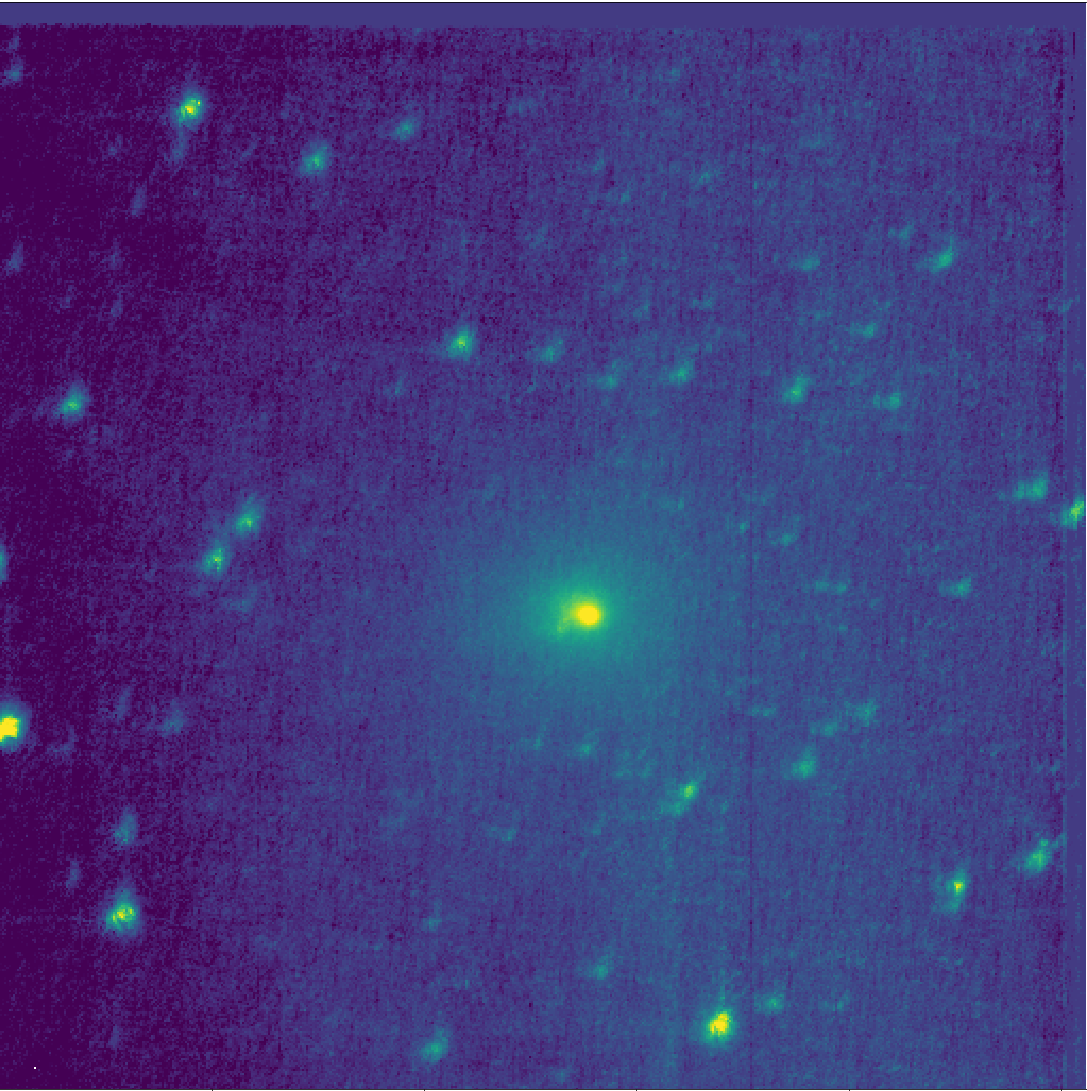
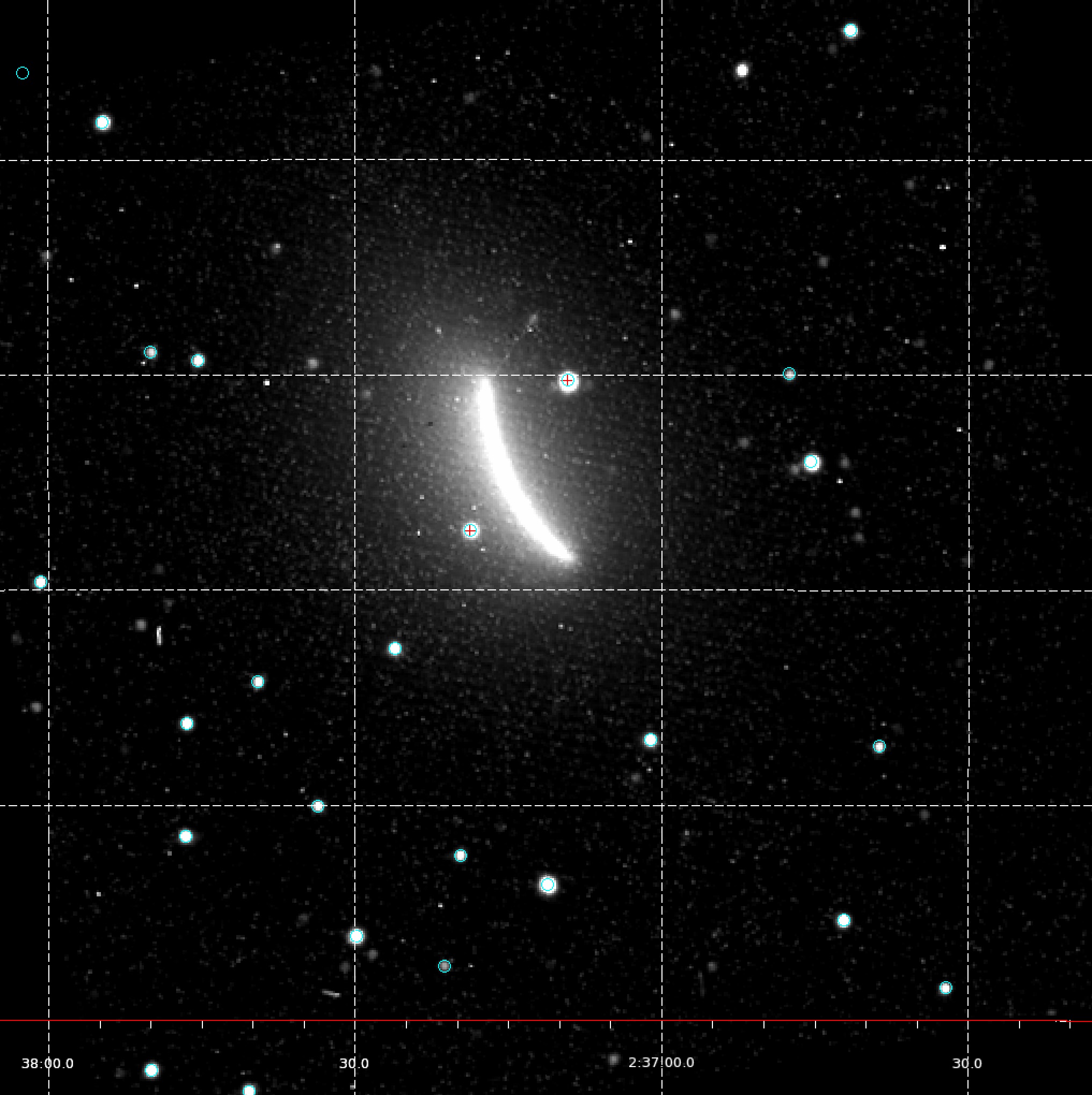
The comet's coma — a glow of gas and dust ejected from its surface by solar heating — brightened as its orbit brought it nearer the Sun and Earth. The comet's apparent motion traces its 5.4-year solar orbit; the tight arcing paths are parallax from NEOSSat's own 800 km orbit, completed every 100 minutes. The "snowstorm" speckling in the imagery comes from energetic solar particles striking NEOSSat's camera as it passes through the South Atlantic Anomaly, a region of weaker geomagnetic shielding.
David Balam, Principal Observer of the Victoria Near-Earth Object project, used NEOSSat to supply measurements to the IAU Minor Planet Center throughout the campaign, and shared the animation and image stack below.
Open Data Access
The Government of Canada is committed to increasing the availability of scientific data and publications as part of its Open Government initiative. The Canadian Space Agency supports this objective by making NEOSSat data available to researchers, students, industry, and the public.
NEOSSat astronomy imaging of comet 46P is available from the CSA FTP site: ftp.asc-csa.gc.ca — NEOSSAT/ASTRO/2018